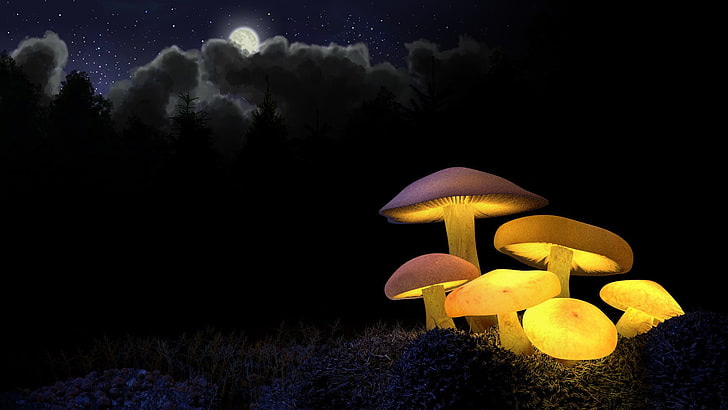
Join the revolution! (The astrological, mytho-mycelial revolution...)
How astrology reminds us that we are not separate from nature- we ARE nature.
Hi everyone. Hope this letter finds you cuddled up in bed, recovering from that potent full moon :)
The vastness of the universe in a cardboard box.
With the full moon in organizational Virgo, I just spent 3 hours going through a box of art that I made when I was a kid, sorting hundreds of drawings and paintings by age range. My mom was amazing enough to collect and save the remnants of my imagination for all these years, and she was often with-it enough to write the year and the idea behind the drawing on the back of the paper.
Lots of the earliest marker drawings from age 3 and 4 were set in outer space, labeled with: “Flower in space”. “Me in a spaceship.” “Outer space pets in a rocket.” “Outer space mommy.” “Outer space gum ball machine”
I guess I’ve been fascinated by our place in this wide universe since before I can remember. Maybe I’ve wondered about how we- us teeny little humans on this big blue marble- fit in here, since before I could write. Maybe a lot of us wonder about this, if we could remember far back enough.
When I moved back to Santa Fe from California a couple years ago, my baby girl was at the age of pointing and learning names for everything around that interested her. Car! Dog! House! Tree! I remember the first time I took her out of her carseat after dark here in the high mountain desert. She looked right up to the dark black sky of a new moon and pointed at the big dipper. “Oooooo!” she cooed.
“Stars," I said. “Stars,” she repeated. “Dipper,” I told her. “Dipper,” she repeated, looking up again at the starry spoon.
Since I moved back here, I too have started to build deeper connections with the planets and stars in in the sky. I gaze up into the darkness from my hot tub in my backyard and can identify Mercury, Venus, Mars, Saturn, Jupiter as they transit through the elliptic. Through an app on my phone I can “see” Uranus, Neptune, Pluto and orbiting asteroids too. Watching the planets dance across the sky through the year feels like re-meeting old friends that I knew as a kid, when I spent countless warm summer nights stargazing from my trampoline or the flat rooftop of my house, creating my own myths and stories from the pictures I saw in the stars above.
Living amongst these crystal clear skies again, now with with the cumulative knowledge I’m learning from astrology charts and astronomy apps, I am more aware of what part of the sky celestial bodies are moving toward and where they just came from (transits). I’m more aware of what far-off constellation or segment of the sky serves as each planet’s backdrop (Zodiac signs). I’m more aware of what geometric configuration each planet is in with the others as they move through space (aspects). And I’m more aware of what place the planets and constellations are in relation to my specific place and time here on earth (houses).
My daughter is now 4. Every night she points up at the glow-in-the-dark stars above her bed and names all the planets in the solar system. “Venus…. Saturn….Mercury… Jupiter… Mars…. What’s that one, mama?…. Neptune…..”
Then, she always says: “Mama, do you know which is my favorite planet?”
“Which one, Tala?”
“Earth,” she says every time, with a huge smile.
“Mine too, Tala,” I always say. “Mine too.”
The Earth is my favorite planet.
It’s impossible to ignore the fact that Earth, our favorite planet, is suffering a lot right now. At the hands of us teeny little humans.
As we descend further into the unpredictable future of climate change, with phrases like “climate grief” and “climate chaos” becoming more and more commonplace, I am constantly reminded of the deep truth behind the statement:
“We are not separate from nature. We ARE nature.”
It has only been in relatively recent times that we have felt separate from the rest of nature, from the Earth. For the vast majority of human existence, we were irrevocably interconnected to her, deeply part of her. For many indigenous people around the globe, this has not ever changed, and the idea that we are nature is beyond obvious. But our modern, Western culture has been so heavily influenced by scientific rationalism, the Great Chain of Being, by Christianity and capitalism and patriarchal systems, that a statement like “We are nature” feels controversial, or sacrilegious…. and far from obvious.
This is strategic. By continuing to popularize the notion that humans are separate from the cycles of life, from nature, from our place within the larger universe, it is far easier to “other” people and environments so we can extract from them. We see this in warfare all the time, strategically dehumanizing the group we are fighting against. We see this trained into the police force. We see this in politics, on playgrounds, in hospitals, in the corporate world.
And we’ve been doing it to the Earth for far too long, othering her and separating ourselves from her so that we can extract from her. In the names of God, or science, or rationality, progress, we have swung too far on the pendulum toward our own human independence and superiority. It’s high time to swing back to relational inter-dependence with the world around us.
How did we get here….?
It is way too easy to fall into this separatist way of thinking. Living in the USA, we are so deeply steeped in it. I don’t think many of us even realize how fundamentally pervasive the last 500 or so years of Western colonial history have been on conditioning us to see the world in a way that is so far removed from the way things actually are.
The emphasis on the empirical, objective, capital-T Truth “out there”, without accounting for the relationship to the observer, was the basis of the modern Scientific Revolution. This revolution led to centuries of dissecting the world up into disparate parts, drawing borders around countries, inventing the concept of race and drawing borders around people, dividing the brain up into segments with phrenology, breaking the body down into bits and pieces, focusing on extractive surgeries (especially of female bodies) and extractive mining of the earth. It led to burning anyone at the stake- first literally and later symbolically- who believed in the holistic interconnection of humanity with the natural world around us.
This is not to put down science, or the multitudes of amazing things we have learned about how the bits and pieces of the world around us work in the past few centuries. The reason scientific modernity was even called a “revolution” is because it exploded out of a deeply oppressive religious culture that put man, as God’s children, at the center of the universe. It was a necessary departure from the concentration of power that the church had at the time. But still, this focus on empirical, data driven “progress” at the expense of right relationship with the environment and other people has certainly done harm as well as good. I believe we are currently at a tipping point of another revolution - one that will allow us to return to the center of our own world, so that we may care for our world as we would care for ourselves.
So… where are we heading?
In the past century, the postmodernist reaction to the “myth of progress” of modernity was distilled into the phrase “It’s all relative”.
In terms of having a relationship with the earth, this postmodern philosophy of cultural relativism really didn’t serve us any better than scientific modernism. By taking human thought and culture out of context of their individual place and time, labeling everything as subjective and relativistic, postmodernism disembodied us further from any sort of real, grounded meaning within our web of existence.
In order to critique the straight-and-narrow line of Western Scientific progress, postmodernists turned everything into a generalized archetype or a universality. And once again, this philosophy didn’t consider that the observers, the creators of these archetypical “universals”, were themselves writing from a hyper-specific place and time: white, male-dominated, Euro-American culture. In their attempts to debunk the notion of hierarchy and progress, by categorizing everything in the world as subjective and relative, they dissolved into nothingness the very thing that makes us human: experiencing meaning through our personal relationships with place and time.
In the past few decades, there’s been a new philosophy emerging called “metamodernism”. From what I know of it, seems like a pretty woke philosophy, especially as it relates to the state of art and literature. Metamodernism describes our current cultural era as one that seeks to bring together and integrate everything that has come before it. It has been described to me as the “integral stage” of human evolution, which unites the seeming paradoxes of “traditionalism” or “pre-modernism” with modernism and postmodernism.
I love that the word “integral” is coming into vogue, and I believe that the discussion of metamodernism is bringing forth some interesting conversations. But it is still problematic, along the same lines that it still separates us from relationship to ourselves, the earth and the universe around us by its very nature. The main problems I have with this discourse is how short-sighted it still is, how linear and stage-based it still is, and how much it still doesn’t consider the eye of the observer in relationship to identification of “truth”. Modernism, as a cultural label, began about 500 years ago, emerging in the 15th century with the Scientific Revolution. By relegating everything before 500 years ago to the label of ‘pre-modern’ or ‘traditional’, rather than giving weight to the multitudinous cultures and wisdoms that came before that time period, this new philosophical label fails in its quest to be authentically integrative.
We cannot dismantle the master’s house with the master’s tools.
Zooming out, I believe that trying to put the human experience into a linear path, one that reacts to the cultural phase that came immediately before it, is the problem. This way of thinking disconnects us from the nature of reality, the nature of time- which is cyclical. If we think of the past 500 years as a tiny speck in the scheme of the long story of humanity, we can revolve back around to the philosophies of our early ancestors, to times long before written history, long before what philosophers call “pre-modern” or “traditional”. If we recognize that the past 500 years of “modernity” have also been 500 years of European colonial expansionism, we can revolve around to people on parts of this planet who never adopted these tenets that say life is no more than the sum of its parts. By zooming out and thinking cyclically, we can revolve back around to the times and places that have been fundamentally connected to the earth and our place within the larger universe.
Many of the dilemmas we are encountering in the world today- and there are many- arise from the disconnection that has grown between ourselves and the world around us in the past 500 years due to slicing it up into basic units. Zooming out again from the narrow lens of Western philosophy and academia, I have encountered those who I believe to be truly revolutionary thinkers, true meta-integrationists. These are thinkers who recognize the truth in Audre Lorde’s statement “We cannot dismantle the master’s house with the master’s tools.” Examples of their teachings are Amber McZeal’s Decolonizing the Psyche, Bayo Akomolafe's We Will Dance With the Mountains into the Cracks, Joanna Macy’s Work that Reconnects, Adrienne Marie Brown ‘s Emergent Strategy and Pleasure Activism, Sophie Strand’s The Flowering Wand, and many more. These thinkers, writers, and artists are actively calling out the hyper-masculine, Eurocentric, colonial bias in science, academia and cultural philosophy. They are speaking to the truths that nature is emergent. That nature exists in cycles instead of straight lines. That we are nature. That we have always been. And that it’s time to start living that way.
If we truly believe that we are nature, we will realize that taking care of the Earth is not a requirement to take care of something or someone else, some foreign or outside entity.
If we truly believe that we are nature, we will realize that taking care of the Earth is taking care of ourselves. That caring for the Earth IS self-care.
The first step to take toward repairing our relationship with the Earth is to first admit that we are in relationship with her. And then to realize- deep within our bodies- that we ARE her.
Astrology centers us in relation with the Earth.
As a lover of anthropology and pre-history, I have always gotten off on zooming way out in order to zoom back in, looking way back to inform the current moment. As a longtime stargazer (and a person with a menstrual cycle), I have always deeply felt the world in cyclical terms, even if my brain and the larger society tried to convince me that time was linear.
Zooming out to the solar system, planets and stars around us helps see clearly that of course we are a part of this Earth. Of course time isn’t linear.
Astrology is about our relationship, as earthly beings, to the universe beyond our little planet. Our relationship to the universe that, for the vast majority of human history, we had access to simply by looking up at the night sky. The universe that, for the vast majority of human existence, it was incredibly important to name, create meaning around, relate to, and share information about.
It’s funny to me how many people who “don’t believe in astrology” (including some versions of my past self) try to debunk it by saying “it’s not science”.
Astrology was deemed “pseudoscience” in the years after Copernicus discovered that the earth and planets actually revolve around the sun, a discovery which ultimately led to the Scientific Revolution. While the invention of telescopes and the discovery of planetary orbits was an incredible one (and is unarguably "the truth”), this discovery doesn’t change the fact that, from our perspective here on earth, the Sun, moon and planets are still moving through space in relation to us. They are brilliant markers for the passage of time as it relates to human life here on Earth.
To compare astrology to modern astronomy and say “I don’t believe it because it’s not science” is to completely miss the point, to throw the gorgeous cosmic baby out with the bathwater. Astrology is not science, per se. But it is not in conflict with science either.
Astrology is a language, or a set of languages, that describes relationships. Through myths passed down over the course of millenia, describing patterns of the ever-revolving relationships between the sun, moon, planets, stars, and us here on Earth, we are able to deeper understand the nature of our relationships with ourselves, with other people, with the oceans, with the seasons of earth, and even with the nature of time itself.
As a language, “I believe” in astrology like “I believe” in Spanish or German or Cantonese. The reason why the language of astrology captivates me even more than any of these natural, location-specific languages is because of the fact that its subject matter is universal- literally. It is not just shared stories relevant to a specific place like Mt. Fuji or the Nile, but instead it is collective storytelling about the movements of the wider universe that surrounds all of us here on Earth.
The shared, collective knowledge of astrology has been independently named, mythologized, and translated in hundreds or thousands of distinct human cultures and languages throughout human existence, from Babylon to Egypt to Greece to India to China to South America. The specific myths that each culture have passed down over time are different from one another, but they all emerged based on each culture’s relationship to the same, mathematically universal, phenomenons: the rotation of the earth on it’s axis, and the revolution of the planets around the sun, amidst a background of stars and constellations.
Astrology itself is a revolution- a bunch of revolutions that we can witness all the time
Back in college, I was the editor of a music & culture zine published through my college radio station. One issue I produced was called “Revolutions”, which included a top 10 list of important Revolutions, from the American Revolution to the French Revolution to the Sexual Revolution to Digital Revolution.
I remember thinking how clever I was to put The Revolution of the Earth around the Sun as Revolution # 1 on the list, just to keep the theme in perspective for my college DJ readers.
In the article, I almost included the revolution of the Sun around the Galactic Center, but ultimately left it out (…a little too obtuse, perhaps). But if you want to talk about perspective, that revolution will really get you:
The sun revolves around the center of of the galaxy at 250 kilometers/second. At this speed it completes one revolution about every 225 million years. Earth is approximately 4.5 billion years old, which means it has lived through about 20 complete loops around the galaxy.
A revolution is simply another turn of a cycle. A revolution is ovulation. A revolution is a breath, in and out. A revolution is a birthday. A revolution is the wheel of life and death. Revolution is the basis of astrology- our perspective from the Earth of the cyclic transits of planets, asteroids, and stars around us.
While in modern times many of us discover astrology through newspaper sun-sign-based horoscopes, Zodiac signs are really just thematic backdrops for the activity that is happening close-to-home in our solar system: planetary transits across the sky as they revolve around the sun. As far as importance to humans goes, these revolutions matter, to us. Gravitational bodies in space affect our bodies like they affect the tides, as our bodies are also gravitational and made of mostly water. But even if that idea is questionable, scientifically debatable, these revolutions around us matter deeply because they act as a clock- a clock that connects us way back in time.
Revolutions are a marker of cyclical time that has been recorded and passed down for all of human history, and who knows how deep into pre-written humanity before that. So, there is collective human consciousness built into these revolutions. They are a beautiful reminder of how time is not a straight line… how, in fact, nothing is a straight line. They are a beautiful reminder of the creative nature of human myth-making throughout longer cycles of time.
Ancient humans didn’t have the option to decide not to join this revolution. Before artificial lighting, we were in a much deeper relationship with the sky above, as it dictated everything about our lives here on earth. Revolutions of the sun and the moon, the king and queen, dictated seasonal changes and rising and lowering tides, and informed our animal bodies when to sleep and wake and how to behave. (Check out the studies of eco-chronology for more on this). For all of our past, relationships with these bright beings in the sky was paramount to our survival, to thriving on this earth as she changes over the year.
Revolutions - of each of these orbiting celestial bodies- are opportunities to come back around to a place where we’ve been before and reflect on that cycle. Each year, we get to reflect on our solar revolution on our birthday. Every 29-30 years, we get to reflect on our Saturn return, when Saturn, the mythological god of structure & time, revolves back to the place in the sky where it was located when we were born. From 2020-2022, we just went through the United States’ Pluto Return, when Pluto, the mythological god of the underworld, came back to the same point in the Zodiac that it was at when the Declaration of Independence was signed. (Fittingly, these past couple of years have given us a lot to think about in terms of America’s foundational colonial underbelly.)
While not as immediate in their Earthly effects as the sun’s seasons and the moon’s tides, each of the revolutions of the visible planet’s- Mercury, Venus, Mars, Jupiter, Saturn- have marked meaningful events throughout the lifetimes of our ancient ancestors, which have been passed down through generations of oral history through storytelling that becomes mythology. The return of a planet to the same place in the sky, historically and prehistorically, has been a marker for a completion of a cycle, a new beginning.
The revolution is mytho-mycelial, and it’s happening all around us
I recently picked up a copy of the new book The Flowering Wand, the first book by the brilliant eco-spiritual writer Sophie Strand. In her work of poetic nonfiction, Strand goes back in time to the oral pre-history of European mythology- back to the earlier myths, the far-back origin stories behind the common Greek myths we are more familiar with today. In these proto-myths, the flowering wand of nature was more powerful than the sword, and the feminine nature of cyclic time and deep connection to the earth were the basis of life and human culture. These eco-spiritual myths were later transmuted and replaced by sword-bearing masculine superheroes, written down, and passed through history until they were captured by Disney in Hercules and countless other popular fairy tales.
One of The Flowering Wand’s most captivating premises is about the emergent quality of myth, with a beautiful metaphor to the fungal life cycle.
Fungi, as many of you probably know, is the world’s largest organism. It exists as a massive living entity growing beneath the surface of the earth, a vast web of mycelium. In the life cycle of fungi, mycelium blooms out of the earth into to fruiting bodies: mushrooms. The fruiting bodies then sporulate, releasing tiny bits of mushroom data into the air. These spores travel through the air, sometimes making it up into the atmosphere. They are then absorbed into clouds and rained back down upon another spot of soil- sometimes in places far from where they originated. Next, these spores germinate below the surface, becoming the branching hyphae of the mycelial network, bringing new information from their previous place of existence to the larger network below. There, they mate with hyphae from different spores, uniting different information from vastly different places.
And on and on the fungus grows, fruiting again and again in response to the right conditions, in a perpetual cycle- a revolution from below earth, up to space, and back again.
Just like myth, says Sophie Strand.
This excerpt from The Flowering Wand illustrates this metaphor beautifully:
…Plants made their way onto dry land some 416 million years ago. But these were not the sturdy trees and sessile flowers we know today. They had no roots. Instead, fungi kept these earliest plants plugged into nutrients and set in place for millions of years before the two developed a converged evolution. Plants “learned” to have roots from fungal networks that predated them by over half a billion years.
Mushrooms, visible aboveground, are the momentary expression of fungi that spend most of their life below ground as branching, threadlike webs called mycelia. These mycelial life-forms grow and explore the soil and connect ecosystems by way of filamentous tubes called hyphae that grow cell by cell.
Just as fungi originally taught plants how to root into the soil, so myths teach us how to root into relation with our social and ecological ecosystems. They narrativize a deep understanding to more-than-human timescales.
Each myth is the mushroom of a certain place, an eruption suited to a specific patch of moss, decaying wood, and forest floor. These mythic eruptions are when a culture senses a need to spread, to find new food, to shift direction. They are reproductive flourishes. Entering into the open air, they sporulate old knowledge in new ways.
To paraphrase:
Myths are the individual fruiting bodies of the mycelial network that is the collective consciousness of humanity. (!)
Individual human cultures are made up of these mythic eruptions, which teach how to root into relation with the specific, place-based social and ecological ecosystems where we live.
From the same material under the surface, myths sprout up and sporulate to help us create new ways to relate to timeless, collective wisdom that has been gathered across time.
The mycelial revolution is here, and it has everything to do with how we tell stories and make meaning.
Astrology allows us to return to the center of our own world - so that we may serve the rest of the world with authenticity
When I was highly skeptical of astrology (which was up until relatively recently), it was because my introduction to it was through “sign-ology”, as my teacher Sam Reynolds calls it. Sign-ology is a reduction of astrology to Zodiac sun signs, which were popularized in newspaper and tabloid horoscopes in the early 20th century and spread like wildfire from there. That’s where the idea of “I’m a Virgo” comes from- over identifying with a small, finite piece of the astrological language: the part of the sky that the sun was in when you were born. Although the sun sign is an important player, with this reductionism is no wonder so many people think astrology is bullshit- having to fit neatly into one of 12 potential Zodiac archetypes and identify with all of it’s ascribed traits is highly improbable.
Over the past decade or so, the more I got into understanding astrology through the lens of my birth chart, a blueprint of the sun, moon, and planets in the sky at a certain point in time, the more I was blown away by astrology’s accuracy and relevance to events in my life. Along my path of independent study of my chart along with that of close friends and family, I was lucky enough to be introduced to the writings of a group of incredibly intelligent, discerning, disciplined, and inspiring, and dare I say revolutionary astrologers.
They were revolutionary, to me, because they were relational.
The Relational Myth-Makers, the Dreamers of the Dreams
This new generation of astrologers felt different from the astrologers I had read before. They were predominantly young, queer, people of color, mostly outspoken in their politics and unafraid to speak truths about issues within our current social web. They were rising voices in the world of astrology at the time that the Influencer movement was being made possible by the new algorithms of social media. By following Instagram accounts of this new generation of astrologers and receiving their easy-to-digest nuggets of wisdom, they reminded me that the language of astrology is the language of relating- to ourselves, to others, and to our more than human kin, including the language of the planets recorded by our ancestors.
The new myths this group was creating from the collective wisdom of the astrological tome seemed steeped in wisdom tailored for our time. Many of them regarded their relationships with celestial bodies as animate, like relationships with people and animals. They thought of astrology as a way to learn from the living world around us, rather than attributing the world around us to a psychological trait in our individual minds. They reminded me, again and again, that time isn’t linear. They helped me reconnect with the relational knowing that I had as a child, in my body, with the moon and the stars and the sky.
Some of these folks are not self-identified astrologers, but still use the language of the stars and planets as it relates to human life. Some are articulate in the newer, astrology-adjacent disciplines of Human Design and the Gene Keys that integrate the ancient language of the stars with ancient systems of knowledge like the Chakras and the I Ching. In the past few years, both astrology and these other fields of planetary-personal inquiry have exploded into the mainstream, utilizing the nature of social media and memes to spread easily shareable information relevant to the transiting planets.
All of this feels, as Sophie Strand puts it, like “sporulating” old knowledge in new ways. Just as the invention of the printing press coincided with and helped spread word of the emerging Scientific Revolution, the proliferation of social media is allowing for a major renaissance in astrology. In a world where content is king and everyone has a device in their hand, tracking the movements of the planets and celestial bodies around the earth provides endless fodder for content, creativity, conversation, and connection.
“The purpose of astrology is to allow us to be our unique selves. The words ‘catastrophe’ and ‘disaster’ are both latin for “against the stars”
-Caroline Casey
Astrology is about the planets, sure, but it’s mostly about getting to know our true selves, and how our lives change with the seasons of time. Within the past year or so, many of the astrologers that I follow have evolved in their beliefs and their writings, bringing new spores down from the ancient sky of traditional astrology to add to the mycelial web of emergent meaning. Instead of just natal chart reading and writing horoscopes, some of their current offerings include things like: building your own dreamworld, timeline jumping and quantum leaping, restoration through re-storyation, liberation through creative practice, myth-mending and co-authoring our own personal mythologies, and using our imagination as currency.
Chani Nicholas offers guided meditations for self-discovery and altar suggestions related to astrological transits on her wildly popular app. Ari Felix writes poetic love letters to the luminaries, reveres the planets as ancestors, and uses this language to help people build their dreamworld. Jessica Lanyadoo sees astrology as a strategy for increasing emotional intelligence. Diana Rose, relational astrologer, talks about astrology as a form of radical self-care. ET Shipley works with people on the margins to help them uncover, clarify and enact their authentic sense of purpose. Daje James supports people in finding and singing the deep song of their lives. Sam Reynolds delves into practical astrology, with the notion that fate (all that seems to happen beyond your control) has two arms- and one of them is our own. Sabrina Monarch offers soulwork, a means to provide guidance to anyone working with a challenging situation, paradox, yearning or existential question. Colin Beddell stewards the message of radical self- acceptance, authenticity, courage, and connection into today's culture. Teo Montoya focuses on synthesizing cosmological and spiritual systems, myths, archetypes, and modalities to find ways of supporting an emerging world in crisis through human development, ecological literacy, Global/Indigenous Futurisms, and reciprocity with our communities and more-than-human kin.
And these are just a few of my favorites.
Ultimately, these folks are using the tool of astrology to help people become rooted within their unique, authentic selves. In learning the ancient language of astrology to gaze into our birth charts, we can de-condition from the existing dominant cultures of capitalism, patriarchy, heteronormativity, etc. We are allowed an opportunity to align with our true selves, and in doing so each of us can hopefully find renewed belonging, meaning, and purpose within our communities and the world around us.
This deconditioning is the work of our times. We are in the midst of a crisis of belonging and a crisis of meaning. As heirs to 5 centuries of isolation, focus on the hyper-individualized self and the myth progress within the capitalist ecosystem, we are in desperate need of new stories. We need new myths to bring us into the future together, myths that originate from each of us aligning with our highest selves. These new myths won’t come from the void- the emerging future must integrate wisdom from the past. Like spores emerging from wrinkled, elder mushrooms: it’s time to “sense a need to spread, to find new food, to shift direction”.
These tools that encourage personal self-discovery, as well as encourage practice of relationality between humans and the more-than-human, are revolutionary tools. We are at a time in history where we cannot wait to be told what to believe or what to do with our lives by the people who hold existing power. Manifestation of a new reality is a matter of de-conditioning from the status quo- letting go what isn’t us and strengthening what is truly us. Liberation is becoming who we really are.
“We will not be free if we do not imagine freedom. We cannot demand that anyone try to attain justice and freedom who has not had a chance to imagine them as attainable.’
- Ursula K LeGuinn
Our Current Cycle: As Above, So Within
One of the central tenets of astrology and alchemy from ancient times is this text from the Emerald Tablet:
This describes a revolution too, a great cycle of existence- “What goes up must come down, what goes in must come out”.
At this particular moment in time, I believe that we have gone as far below as we can go, at least for this cycle. For the past 500 years, we have utilized science and technology to dig deep below the surface, to dig deep into the reasons behind the mysteries of life- and we are beginning to hit rock bottom. We have created irrevocable damage by extracting below the earth, literally mining and fracking and destroying what is beneath the surface in the name of progress.
I believe that the time has come to look above again, remembering that we are a part of something much larger than ourselves- the earth, the orbiting revolutions of our solar system, and the stars and universe beyond. By joining the new astrological revolution and looking above, we can remember how interconnected the earth is to the larger universe, and how interconnected we are to our place on this earth. Since this is a new cycle, it won’t be the same exact looking above as people were doing in the last cycle, ‘pre-modern’ times. It will be new, bringing with it the wisdom we have gained by going so far below. By looking above to the same depths that we currently look below, perhaps we can again learn to love our planet like we love ourselves.
Similarly, I believe we are at the cusp of having gone as far without as we can go, for at least for this revolution’s cycle. For the past 500 years or so, we have been empirically looking outward to find the truth rather than trusting ourselves and looking within. In the last several years this limit has come to a head with a disorienting 1-2 punch: First, Donald Trump led his candidacy and presidency with the strategic notion of “fake news”, strategically claiming that any information could be manipulated, that there was no such thing as truth. Next, the Covid pandemic forced us to make personal, life-or-death decisions about our health and the health of our families and communities on a daily basis, without solid answers from without.
During the past couple of years, many people realized there was no where to look for the perfect truth or right answer, that there was no outside entity that would reliably tell us the best course of action to take. As we begin to look within again, it is up to each of us to internally gauge that notion of truth for ourselves. Within this process, it is up to us to decide where “we” stop and others begin. In a public health crisis like the pandemic, the truth that we are all interdependent is impossible not to see. In times like these, it becomes more and more important to form a consistent practice of checking in within ourselves- within our families, within our communities, and within our place on this Earth, rather than relying on an outside entity to tell us what to do, how to behave. When we go within to find the answer, a new solution may emerge for each particular situation. When we go within, we must learn to deal with complexity. In doing so, self awareness, and even more so relational awareness, become tantamount.
I find the collective mythology of astrology, and the constancy of the planetary cycles, to be a beautiful way to practice self awareness as it relates to relationship to the larger world around us. There is great power of being conscious of the sky above. My ongoing relationship with the moon, sun, and planets makes me feel a sense of belonging with other people around the globe, who are also looking up to the same sky. It also makes me feel a deep belonging with ancestors- my direct ancestors, and all human ancestors. Because with the study of astrology comes a deep, emergent study of the intricate mythologies that span every human culture throughout time. In this way, astrology unites us through time and space.
By attuning to the cycles of the earth amongst the planets amongst the sun amongst the millions of stars in our galaxy, we have the opportunity to sporulate new, creative myths into the air - while still maintaining connection to the mycelial breadth of human consciousness that has been growing beneath the surface since the beginning of humankind.
It’s time to lift your skinny fists like antennas to heaven, get to know your authentic self, connect with your community, care for the Earth, start creating new myths and building your dream world. But first, get some rest. The revolution will happen with or without you, and it’d be a hell of a lot better with you.
Until next time,
xoxxo, Alison


I haven’t read this entire section but just the first two paragraphs I’m like hell yah! My mom saved everything!!! She is not longer in her human form walking this earth but her spirit/soul is here. In fact her soul might be trapped/stuck here and so I’m working with a shaman to return her to the light! Anyway we need to connect! I sent you a what’s app message hopefully you got it!